Recent Projects
Merchandise Planning
Master Art Of Allocation
After the demand planner finished forecasting the sales plan for the next season, I started to create a store-level allocation plan. in fashion, Spring/Summer starts Feb, and runs until Jul. Fall/Winter runs from Aug to Jan. On the sales plan report, we can obtain metrics like planned sales units, planned sales unit by week, by store, planned sales $ in cost and retail, delivery schedules, launch start and end date, etc. When the season kicked off, I conducted the initial allocation by bulk to all stores at the beginning of each week. When the week went on, I implemented daily replenishment adhering to weekly sales plan and store stock targets.
Allocation and replenishment are the process of distributing individual item quantities from warehouses to specific stores based on analytical approaches that recognize the performance of these items. Metrics that are used to measure allocation optimization include sales, store on hand, receipts, warehouse stock, top sellers, promotion items, etc.
.png?timestamp=1567479892596)
I use Soho House as an example showing you how I approach SKU level allocation at a daily basis. This task is required to be patient, attentive and detail oriented.
As you see the above chart, the stock holding day is the critical standard for determining allocation quantity. 14 days is a standard amount for stock holding days. If the stock holding day is less than 14 days, it indicates lack of stock, if it is more than 20 to 30 days, it most likely indicates excessive of stock. It varies according to the type of products. For product like socks, which usually display and sell more quantities, 20 to 30 days’ stock holding day is normal, for product like luggage, which display and sell fewer quantities, therefore, 10 to 14 stock holding day is acceptable.
The formula of stock holding day is
Stock holding day = (total allocation qty + receipts + store on hand – store weeklysales) / store weekly sales * 7
It means that total stock / total week sales *7, which is similar with the stock to sales ratio.
After determining the allocation quantity per SKU, the next step is to calculate the total allocation in dollar for that store classified by class and create a daily allocation report to showcase the total allocation amount breaking down by department, class and subclass, in this way, we can monitor and ensure that weekly allocation adhere to weekly sales plan.

bUSINESS aNALYSIS
6 Metrics to Identify Opportunities on the Merchandise Plan
There are six key metrics list at the right that indicate whether the business grows or not and help us to see growth opportunities. If you'd like to learn how to identify risks, check my another article 4 Metrics to Identify Risks on the Merchandise Plan.
- Stock to Sales ratio
- Turn (Turnover)
- Plan
- Markdowns
- Margin
- Sales per square foot or sales per channel
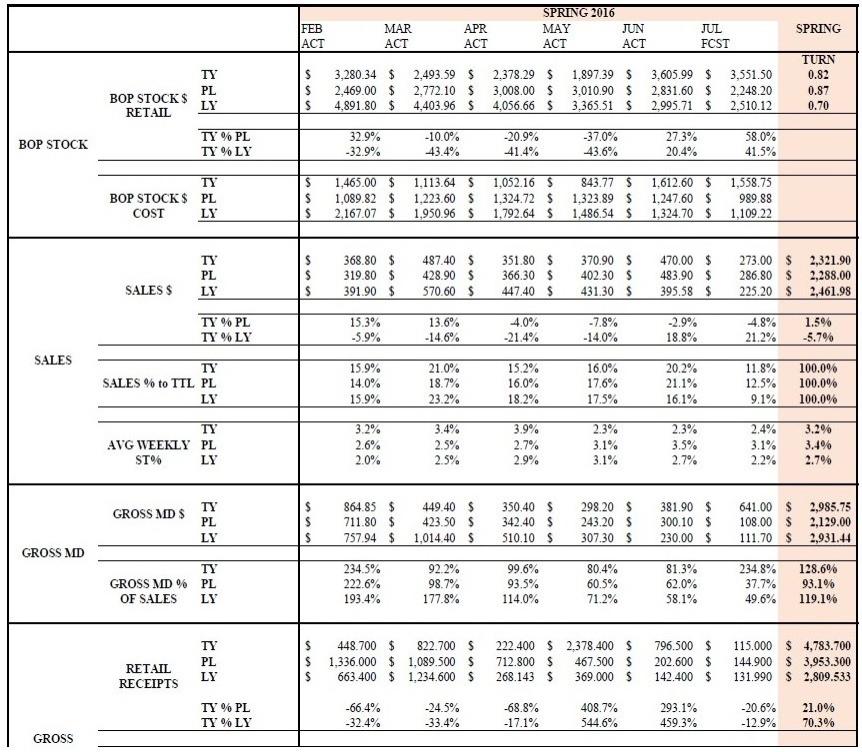
Stock to Sales ratio is a measure of the BOM to the sales achieved. We got the stock to sales by month, for example, in this year Feb, we have 3.28 million in stock and $368,800 in sales so our stock to sales ratio is 8.89.
We have to say that such a stock/sales ratio of 8.89 is high. This is really bloated if you're looking for industry standard. An ideal world for fashion would be about 2 to 1 ratio. It is not easy to achieve in these days. Particularly a large brand, typically more likely sit around like 5 or 6, but close to get 2 or 3 is ideal. 3 pieces of inventory to every 1 you sell is considered normal. In fashion, we need more inventory because of size and color. There are usually 5 sizes, so we are not sure which size is going to sell so we need to carry inventories of all sizes. If the stock to sales ratio is over 10, we have a real issue in fashion.
Turnover is the number of times you buy and sell through the average amount of stock. Usually, it is measured over a period of 6 months or a year. The turn varies. In the fast fashion, such as H&M, forever 21, the turn would be 14-17, 20, 25. The branded collection such as BCBG MAXIMAZRIA may turn 1 or 2 times a year.
Turn and stock to sales is related. The higher the stock to sales, the more inventory you carry that are not selling, the lower your turn is going to be. The higher the turn, the more efficiently you are moving your inventory, which means more inventory out and more inventory in.
If the products are in demand, the retailer can drive purchase and traffic frequency by increasing the number of times the customers visit the stores. For example, let’s look at business risks and opportunities of fast fashion like forever 21, it usually has 14-20 turns, the price is low and leading, and not as promotional as a higher-end brand due to low initiate makeup. It spends huge design and development budgets, operates super active DC because receiving goods often quickly and get rid of goods quickly. Consequently, the risks often are sizing related, broken sizing quickly. It tends to be high price pressure; they must have the right price otherwise it may not sell through as quickly.
How to increase turn?
- Create more drops. Ensure your customers come to the stores or visit E-commerce more frequently and she or he can see what they are looking for on products.
- Be more competitive on pricing. Your products are priced what your customers perceived to be at.
- Sharpen more frequent promotions to drive the traffics into the store.
- Drive more trendy merchandise which has short life cycle to get the customers into the store.
- Never drive out of the stock of the basics, the basics could be the highest turnover items, especially the basic colors of the basics. For example, the Black leggings should never run out of sizing.
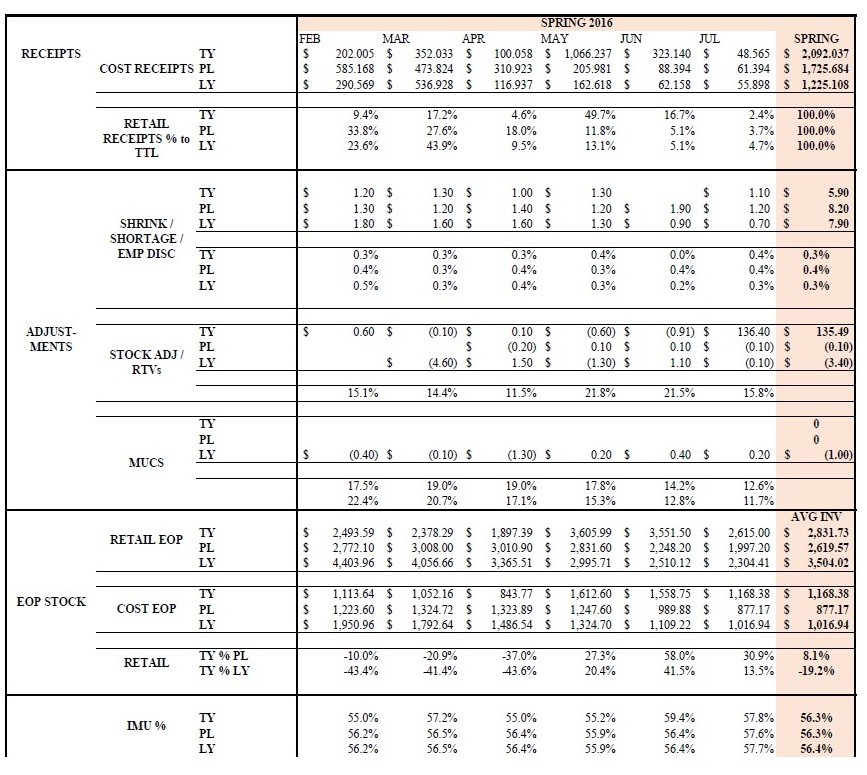
The second factor that indicates whether we have a business opportunity is the plan. We need to plan on every line including sales plan, BOP plan, receipts plan, and markdown plan. As a retailer, we brainstorm how we can continue to take advantage of positive trends, and address risks where we shortfall with plans. For example, versus plan, we took more receipts in certain months and had a major shortfall on the receipts in some months. The IMU could be higher than planned. The Margin is below the planned despite we push 1.5% increase in sales.
A lot of retailers often put on weekend markdowns when they see overstock. Some of the promotions are successful and drive more revenue/ profits but some of them are losing money by giving discounts to the customers. Yes, markdowns drive traffics and sales units but lose profits at the end due to low margins and more operating costs. It is not worthwhile to promote if you spend more markdown dollars than you generate in extra sales. It does not make sense to attract "wrong" customers who just look for taking advantage of discounts. It is important to track the markdowns and compare before and after markdowns. Make the case to include Only markdowns or promotions that are worth doing that drive increases in sales.
How to reduce the number of promotions to offer a way to generate more sales from existing promotions?
- First, scope and go deeper, more meaningful promotions that include as many engineering promotions as possible. Second, plan the promotion before the products ever made. For example, we can plan the products on a higher markup so when it goes on 40% off promotion, we still make the margin.
- Reduce regular markdown by selling more on full price items.
- Reduce on the quantity of orders. If you have a sizing issue, increase ordering the quantity of popular sizes.
- If you take more markdowns because you are broken two weeks into your sales cycle when you have six weeks sales cycles, that is too early. You need to order every size to satisfy the customers that are coming in.
- Improve model stocks. Do not sit on extra inventory. For instance, if you bring the same style on the next season like white camisole, don’t put on the different sku, put under the same sku. Also make sure the retailer to put under the same sku so you markdown the old camisole, only bring in the new delivery of white camisoles.
How to increase IMU?
Engineer promotions will help do this and I'm sure that you are in fact still achieving a higher price on your promotions. You can also increase your margin by supporting your retailer with allowances or check at the end of the season. You can also increase your margin by RTV, taking back goods that aren’t selling which gonna result in a good markdown for your retailer.
The better sales per square foot / per door, the better the sales team generate sales in cash. It is a productivity metric to make sure to make good use of the space and door as best you can. For example, in Feb LY (70 doors) we are doing $4.90, in Feb TY (80 doors) doing $4.61 per door. We are doing less than LY. The same situation incurred in Mar, April, May. Until in June and July, TY sales per door exceeded the LY sales per door.
How to increase sales square footage?
Look for ways gaining more square footage which drive regular price sales, better placement in the store, product knowledge, Provide an incentive for staffs and customers. Gift with purchases, for example, is a good way to provide incentives without occurring of costs.
bUSINESS ANALYSIS
4 Metrics to Identify Risks on the Merchandise Plan
© Copyright vivianjiangyuan